Opening your MyNCEES account to see an "Unsuccessful" result is a punch in the gut. After spending weeks or months buried in the FE Reference Handbook, it is natural to feel frustrated, overwhelmed, and unsure of what to do next.
Once the initial disappointment settles, take a deep breath. Failing the FE exam is not a reflection of your potential as an engineer. It is simply a data problem.
Depending on your engineering discipline, between 30% and 40% of first-time test-takers do not pass on their first attempt. The biggest mistake candidates make after failing the FE exam is going right back to page one of a review book and repeating the exact same routine. If your initial approach did not cross the passing threshold, your retake plan cannot be a carbon copy.
NCEES provides every unsuccessful examinee with a customized tool: the FE Diagnostic Report. Used correctly, this report gives you the exact blueprint to pass your FE exam retake.
1. Official NCEES FE Exam Retake Rules & Fees
Before re-booking your exam date, you must understand NCEES's testing policies.
Testing Windows. NCEES divides the year into four 3-month testing windows:
Frequency Limit. You can take the FE exam once per testing window, and no more than three times within a 12-month rolling period.
Retake Cost. Each attempt requires the full NCEES registration fee (currently $225) plus any specific board fees.
State Board Exceptions. State licensing boards (like Texas TBPELS or California BPELSG) are permitted to be more restrictive than NCEES. Always verify your jurisdiction's rules in your MyNCEES portal before scheduling.
Calendar Trap Warning. The testing window rule is a calendar boundary, not a forced waiting period. If you test in late March and fail, you are eligible to sit again in early April. However, eligibility is not readiness. Rebooking 10 days later without changing your preparation is the fastest way to lose another $225.
For the full breakdown of exam mechanics, see our complete guide to the FE exam.
2. What You Receive (And What NCEES Doesn't Tell You)
If you pass, NCEES only reports a "Pass." You do not receive a numerical score or breakdown.
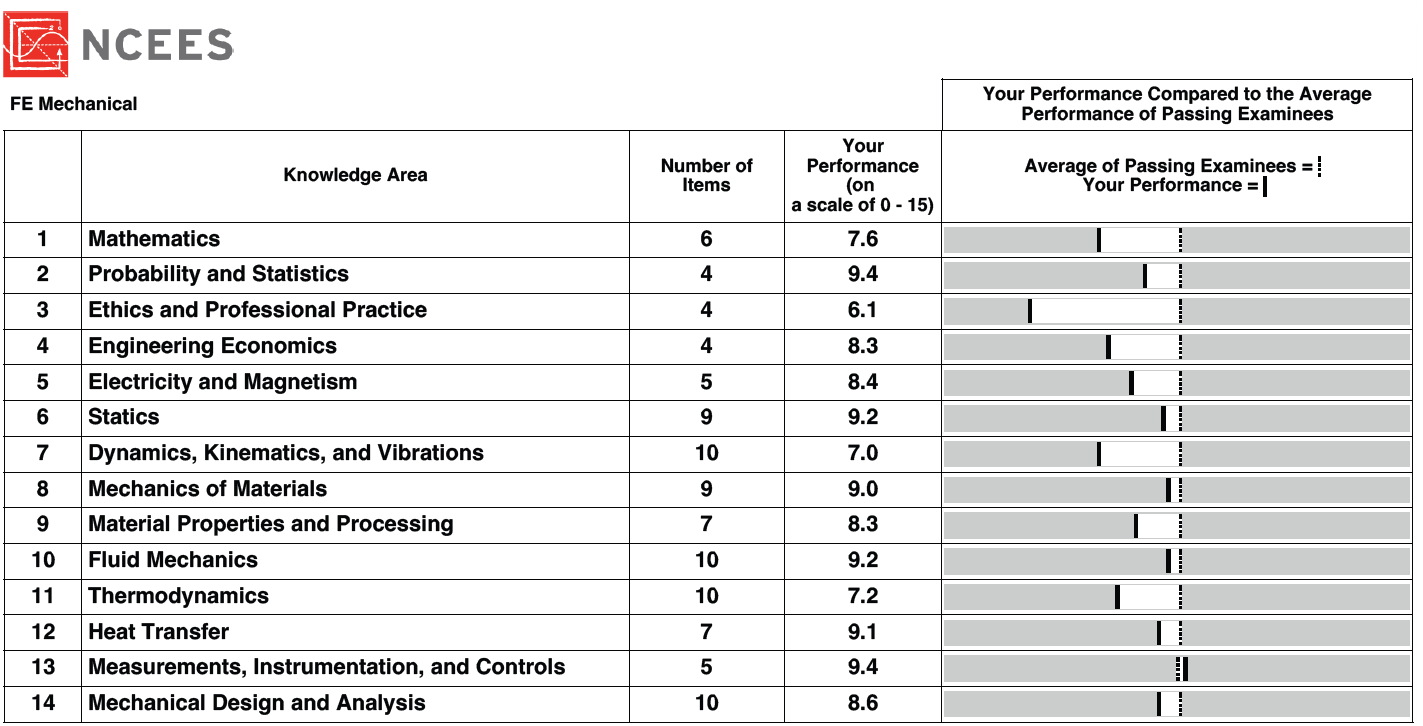
If your result is "Unsuccessful," NCEES posts a downloadable PDF diagnostic report to your account (typically 7 to 10 days after your exam, on a Wednesday morning).
Your report outlines your performance across every subject area in your discipline specification (for example FE Civil, FE Mechanical, FE Electrical, or FE Other Disciplines).
What the Diagnostic Report Shows:
What the Diagnostic Report Does Not Show:
3. Interactive Tool: Analyze Your Diagnostic Report
Instead of trying to estimate your score by hand, upload your report PDF or image, or enter your subject scores below, to calculate your weighted performance and reveal your highest-yield priority areas instantly.
FE Diagnostic Report Analyzer
Upload your NCEES diagnostic report and this works out your weighted performance and ranks your knowledge areas by how many points each one can actually win back. Everything runs in your browser. Your report is never uploaded anywhere.
4. The Ranking Mistake Almost Everyone Makes
The most common trap candidates fall into when reading their report is making a list of their lowest scores and studying from worst to best.
Priority is not just your lowest score. It is gap size multiplied by question count. A large point deficit in a 4-question topic is worth far less to your total score than a moderate deficit in a 14-question topic.
Topic Priority Index = (Passing Average − Your Scaled Score) × Question Count
| Knowledge Area | Question Count | Score Deficit | Real Point Potential | Retake Priority |
|---|---|---|---|---|
| Statics / Mechanics | 13 | Moderate | Very High | Priority 1 |
| Fluid Mechanics | 12 | Moderate | High | Priority 2 |
| Heat Transfer / Dynamics | 7 | Large | Medium | Priority 3 |
| Ethics | 5 | Large | Low | Priority 4 |
| Engineering Economics | 5 | Slight | Low | Priority 5 |
Notice that Ethics sits near the bottom despite a large score deficit, because you cannot win the exam on 5 questions. Meanwhile, Statics sits at the top because closing a moderate gap across 13 questions moves your total score drastically.
5. What the Diagnostic Report Cannot Tell You
A low scaled score in a topic area can be caused by six completely different issues, and the report cannot distinguish between them:
If you run out of time, you bleed points across the final 20 to 30 questions, which shows up on your report as a flat, mediocre performance across subjects. Studying more theory will not fix a pacing problem.
6. How Your Second Study Plan Must Differ from the First
| First Attempt (Linear Review) | Second Attempt (Diagnostic Execution) |
|---|---|
| Reading chapters cover-to-cover | Targeting high-weight, low-score topics first |
| Watching video lectures passively | Active timed problem solving with the PDF Reference Handbook |
| Working problems by single subject | Mixed problem sets across topics |
Strategic step-by-step retake plan:
Execute a 3-pass pacing strategy:
More on building the study routine itself is in our guide on how to pass the FE exam.
7. How Long Should You Wait Before Retaking the FE?
Resist the urge to rebook for next weekend unless you missed passing by a microscopic margin. Base your timeline on your diagnostic report data.
The "close call" (4 to 6 weeks). Most scores are near passing (8.0 to 10.0) with only one or two weak outlier topics. Spend 4 to 6 weeks on focused problem sets for those topics alongside full-length timed practice exams.
The "concept and pacing gap" (8 to 12 weeks). Multiple core subjects fell well below the passing baseline. Give yourself 2 to 3 months to rebuild fundamental concepts, complete 300+ new practice problems, and master handbook lookups.
How STEM Tutor 360 Can Help You Pass
Failing the FE exam is frustrating, but you don't have to figure out your retake strategy alone.
At STEM Tutor 360, we specialize in personalized, one-on-one FE exam preparation for FE Mechanical, FE Civil, and other FE disciplines.
We work directly with retakers to:
Ready to turn your diagnostic report into a passing result? Book a free consultation, bring your diagnostic report, and let's map out your path to getting certified.